

Mobile phones and handheld devices have evolved far beyond their origins as simple tools for making calls and sending text messages. Today, modern smartphones are ubiquitous handheld devices that seamlessly blend communication, entertainment, shopping, education and business.
In 2026, technological advances such as 5G and AI have already been integrated into mobile devices, pushing the limits of handheld technology and further integrating them into people’s lives. As businesses demand a faster pace and greater connectivity, having a mobile phone that is constantly reachable is critical to everyday business operations.
Smartphones have become lighter, more portable, and feature superior connectivity, allowing users to access the internet seamlessly via Wi-Fi and mobile broadband.
As a specialist Sydney SEO agency, we craft business growth strategies that leverage the mobile phenomenon, serving clients across many industries in Australia.
Latest Mobile Devices Statistics in Australia 2026
Australia is a developed nation at the forefront of technological advancement. Since the introduction of mobile phones, Australians have adopted them for a myriad of purposes, driving continuous growth in the digital landscape.
How many people use phones in Australia?
Data from Statista shows that the number of mobile phone users and penetration levels in Australia are continually rising. From 19.9 million users in 2017, the number of Australian smartphone users is projected to increase to 23.6 million by 2026. This rapid rise reflects consumers’ growing appetite to engage with online products and services.
How many Australians don’t have a smartphone?
There are very few Australians without a smartphone today. The latest Digital 2026: Australia report by Meltwater and We Are Social revealed that 34.1 million cellular connections were active in the country in late 2025, equivalent to 126% of the total population. Smartphone access has become a basic necessity for daily life across the country.
What is The Most Used Phone in Australia?
Looking the Apple, Android and feature phone markets, here are the highly sought-after phones in Australia, handpicked from PCMag:
- Apple iPhone 17: The most popular iPhone for the general public
- Samsung Galaxy S25 Ultra - The best phone for creative users
- Google Pixel 10 Pro - Best Android phone for most users
- Google Pixel 9a - Top midrange Android phone
- Samsung Galaxy Z Fold 7 - The best folding phone
- Samsung Galaxy A16 5G - Most affordable Android phone
- Apple iPhone 17 Pro Max - The phone with the best battery life
- Motorola Razr Ultra - The best flip phone
Is Apple or Samsung more popular in Australia?
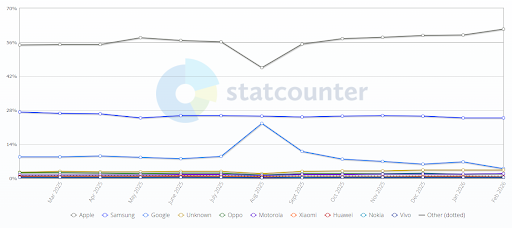
The latest February 2026 report by Statcounter reveals that Apple is still the leading smartphone brand in Australia, with a 61.45% market share, while Samsung trails at 24.78%. With 243 million units sold worldwide, the iPhone dethroned Samsung in 2025.
5G, The Internet, and Mobile Devices in Australia
Smart mobile devices remain among the most impactful technological inventions of our time. With internet connectivity, users can reap the full benefits of a mobile device, going online whenever and wherever. GSMA Intelligence data indicate that 100% of mobile connections in Australia are now considered "broadband" (via 3G, 4G, or 5G networks).
5G Networks Across Australia
As of early 2026, the 5G network in Australia has reached a high level of maturity, driven by widespread coverage, especially in populated areas, and the deployment of 5G Standalone (SA) technologies. Optus 5G dominates the market with approximately 80.5% of the population.
Australia’s Dividends for Expanding 5G Networks
Adopting new technologies in businesses and industries is an intense race within and beyond Australia. Businesses are now recognising the potential of 5G applications and expanding their use of 5G networks.
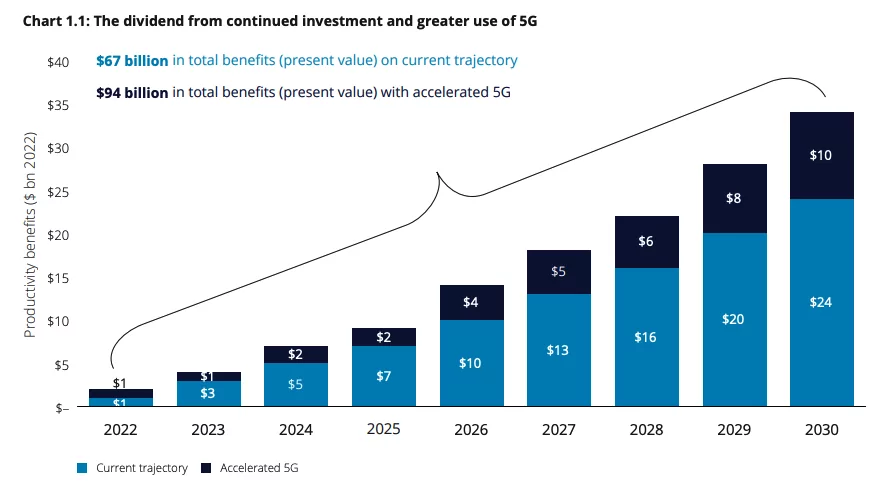
The latest Deloitte statistics forecast increased dividends from 5G applications, as they improve business readiness and integrate more businesses into the network.
5G and Australia’s Telecom Industry
5G is the current foundational global wireless standard connecting everyday devices, vehicles, and infrastructure with low latency and multi-gigabit speeds. The industry is currently rolling out 5G-Advanced (5.5G) for enhanced AI integration and efficiency, while actively developing the upcoming 6G standard to unlock even faster speeds and interconnected sensory networks.
According to the latest Mobile Network Experience Report in Australia, Optus has emerged as the mobile network with the fastest 5G download speed, with records clocking at 212.3 Mbps, about 18.7% faster than Telstra and roughly 1.34 times (34.5%) faster than Vodafone.
- Optus: 212.3 Mbps
- Telstra: 178.9 Mbps
- Vodafone: 157.9 Mbps
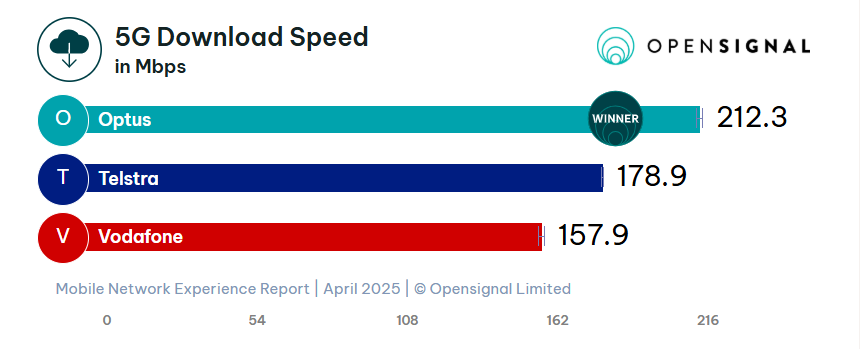
Source: Opensignal OpenSignal’s latest Mobile Network Experience report clearly shows Optus’ dominance, with five outright and five shared wins across 14 categories. Meanwhile, Vodafone received two sole and five shared wins.
Internet and Mobile Device Users in Australia
Due to the availability of 5G and smartphones in Australia, accessing the internet at any time and place has become much easier. In addition, the country is also one of the developed countries with fast mobile internet speed.
Ookla Speedtest Global Index for mobile ranked Australia at 42, with average download speeds of 121.01 Mbps and upload speeds of 11.46 Mbps. The country ranked 46th for fixed broadband speeds with average download speeds of 158.62 Mbps and upload speeds of 40.87 Mbps.
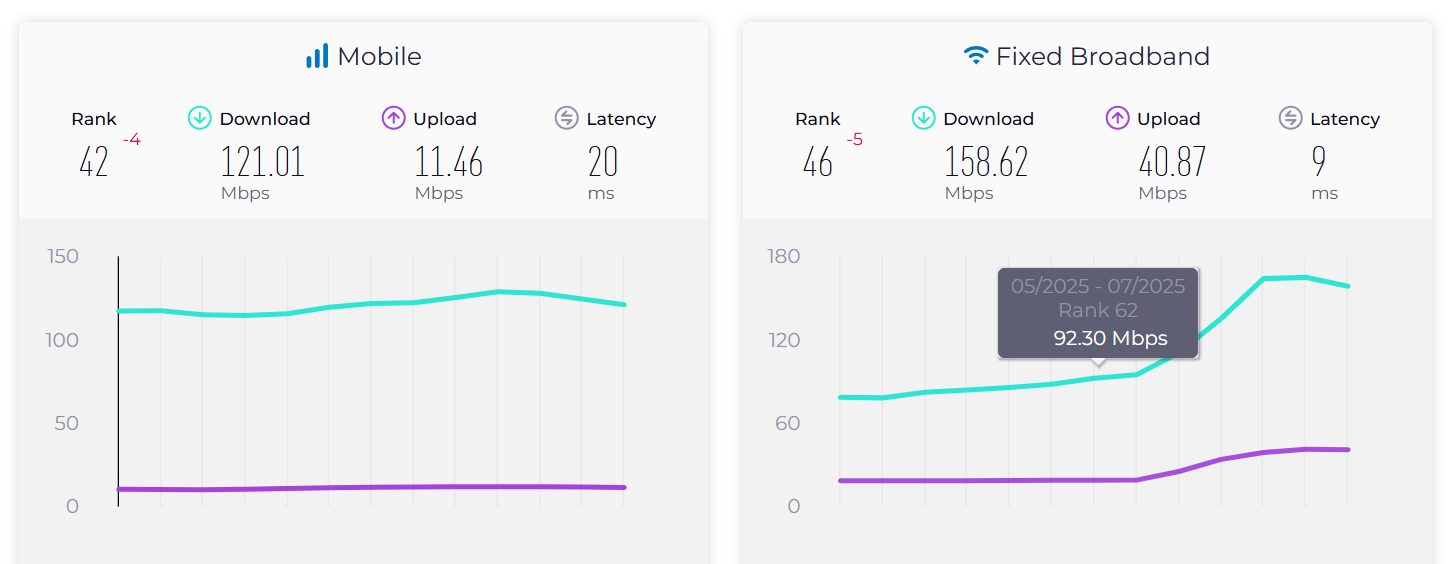
Source: Ookla It is unsurprising that internet users in Australia typically spend an average of 41 hours a week browsing online across various devices. However, despite this heavy reliance on connectivity, mobile devices now account for around 61.9% of all web traffic in the country as of January 2026. This highlights the key role smartphones play in Australians’ daily lives.
How Australians are Using Their Mobile Phones in 2026
Australians treat their smartphones as all-in-one tools, replacing everyday items such as phonebooks, maps, physical cameras, calculators, clocks and books.
- Communication & Social: A large share of usage is devoted to social media and messaging apps.
- Utility & Finance: Handling routine tasks like navigation, digital payments, and transferring money.
- Entertainment: Taking photos, checking news/weather, tracking fitness, and streaming movies.
- Gaming: Mobile gaming has risen significantly alongside desktop gaming on gaming PCs.
- Dual Use: With 34.1 million cellular connections in the country, many Australians maintain multiple connections (e.g., one for personal use and another for work).
How Australian Children Are Using Their Mobile Phones
Recent data shows that around 90% of Australian children use mobile phones for more than 20 hours per week, which is 43% above the recommended usage guidelines. This is a sharp increase from 2019, when children averaged only 10 hours per week.
Most Australian kids use their mobile phones to play games, take photos or videos, and use phone apps. However, while these devices offer convenience and entertainment, the rapid increase in screen time has also raised growing concerns among experts about the possible social, developmental, and mental health effects of excessive phone use.
- Teens average about 7.5 hours of screen time per day, excluding time spent on homework.
- 48% of adolescents who spent five or more hours on their phones daily had thoughts about suicide or made plans.
- 57% of teens who use their phones at bedtime experience sleep problems.
- Children who used their phones for more than 2 hours per day scored lower on thinking and language assessments.
The Duality of Mobile Phone Technology
Positive Effects of Mobile Phone Technology
The latest Deloitte Connected Consumer Survey shows that Australians increasingly rely on their mobile phones for connectivity, health tracking, and safety.
Here are some reported positive effects mobile phone technology offers.
- Meaningful Connections: Mobile phones help maintain social relationships, with a focus on technology that enhances rather than hinders daily life.
- Health and Well-being: The report shows rising reliance on mobile devices for health monitoring, revealing a positive shift towards proactive health management.
- Safety and Convenience: Mobile phones are critical for enhancing security and accessing information anywhere.
The report also revealed that consumers are actively setting boundaries to manage screen time and digital fatigue.
Negative Effects of Mobile Phone Technology
A 2025 study on understanding smartphone usage behaviours among a diverse Australian sample revealed interesting results. The study validated a Brief Problematic Smartphone Use and Dependence (BPSUD) scale to measure smartphone dependence among users.
- Problematic smartphone use is associated with behavioural dependence, including frequent checking, difficulty limiting use, and strong reliance on the mobile device.
- The study highlights growing concerns that increased reliance on smartphones may lead to addictive use, emphasising the need for better monitoring and research.
Overall, the findings suggest that while smartphones are critical in modern life, their growing use requires greater awareness and responsible habits to avoid dependence.
The Impact of Mobile Devices on eCommerce
The merging of the internet and mobile phones has proven to be a powerful tool for businesses, especially in eCommerce. Smartphones have drastically transformed the way business owners conduct business online.
As the 10th-largest eCommerce market worldwide by revenue, Australia benefits tremendously from mobile technology. According to Fox & Lee, approximately 18 million Australians are projected to shop online in 2026, a significant portion of the country’s population, with many purchases likely made through smartphones.
Shopping and Searching for Services
Smart mobile devices have opened up countless opportunities for shoppers to find the products and services they need and the brands they want.
Online mobile shoppers can even filter search results by their preferences, such as location or service area, product colour and size, and more.
Online Purchasing and Booking
Mobile shopping enables faster transactions through checkouts, digital payments, and online booking. This eliminates the need to visit physical stores and pay over the counter for the goods you want.
Brand Awareness and Customer Engagement
Small and medium businesses (SMBs) that employ digital strategies (such as leveraging SEO services, Google Ads, or Facebook Advertising) have a better chance of generating leads and becoming known to their target market than brands with physical outlets only.
Given Australia’s relatively high smartphone penetration, companies can harness the full potential of presenting their brand online and making their websites mobile-friendly. Besides, half of SMBs in Australia already employ mobile-friendly websites to drive leads.
Brand Loyalty
By delivering a seamless, highly personalised mobile experience, companies build lasting trust and loyalty with their customers. Today, this requires moving far beyond basic mobile-responsiveness to offer fast, intuitive, and AI-enhanced interactions across all devices.
As mature 5G networks and 5G-Advanced technologies power edge computing, entirely new omnichannel and in-store business opportunities are unlocked, from augmented reality retail to real-time, interactive customer service.
Furthermore, it is forecast that companies will steadily adopt digital technologies, so we can look forward to a future where mobile devices play a major role in business and eCommerce.
If you want to read more industry insights and love fresh data, check out our other statistics posts:
- Australian Local SEO Statistics
- Australian Voice Search Statistics
- Australian Google Business Profile Statistics
- Australian eCommerce Statistics
- Australian Buy Now & Pay Later Statistics
- Australian Apple iPhone Statistics
- Australian Samsung Phone Statistics
Global Mobile Phone Statistics FAQs
Daniel Law
Daniel Law is the SEO Director at Red Search, a specialist SEO agency based in Sydney, Australia. With over 15 years of experience in the industry, Daniel has a wealth of knowledge and expertise in search engine optimisation. He is passionate about helping businesses achieve sustainable growth through effective SEO, and stays across every shift in the search landscape.